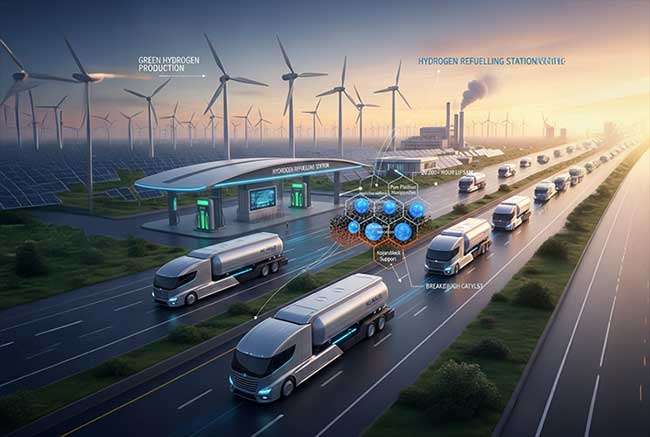
For decades, the vision of clean, long-haul trucking has been tantalizingly out of reach. Electric batteries, while transformative for passenger vehicles and short-range logistics, face the immutable laws of physics when confronting the 500-mile hauls, heavy payloads, and rapid refueling demands of freight transport. The industry has looked to hydrogen fuel cells as the most promising solution—a technology offering electric drive, zero tailpipe emissions (with only water vapor as a byproduct), and refueling times comparable to diesel. Yet, a persistent obstacle has remained: durability. How do you create a fuel cell robust enough to survive the punishing, million-mile lifespan of a Class 8 truck?
That question now has a groundbreaking answer. A research team at the University of California, Los Angeles (UCLA) has achieved a technological leap that shatters previous limitations, engineering a fuel cell capable of operating beyond 200,000 hours of stable performance. This isn’t an incremental improvement; it’s a paradigm shift that paves the concrete highway for the hydrogen long-haul era.
Decoding the Durability Dilemma
To appreciate the magnitude of this breakthrough, one must understand the Achilles’ heel of conventional fuel cells: degradation. At the heart of a proton exchange membrane (PEM) fuel cell—the type best suited for transportation—lies an electrochemical reaction where hydrogen and oxygen combine to produce electricity, heat, and water. The core of this system is the membrane electrode assembly (MEA), a sophisticated sandwich of catalysts and proton-conducting materials.
Over time, the relentless chemical reactions and thermal cycling cause the platinum catalyst nanoparticles on the cathode (air side) to dissolve, agglomerate, or detach. Simultaneously, the carbon support material corrodes, and the membrane itself can degrade. This slow decay reduces power output and efficiency, ultimately requiring costly replacement. For heavy-duty applications, where engines routinely last 1-1.5 million miles (equivalent to roughly 25,000-40,000 operating hours), previous fuel cell stacks fell critically short, often targeting 25,000 hours as a ambitious goal. The economic equation for fleet operators simply didn’t add up.
The UCLA Innovation: A Radical Reinforcement
The UCLA team, led by distinguished materials scientists and chemical engineers, approached the problem with a radical redesign at the atomic and molecular level. Their solution is elegantly multi-faceted, targeting the degradation pathways simultaneously:
- The Ultra-Stable Catalyst Support: Instead of using conventional carbon black, which corrodes under fuel cell conditions, the researchers developed a novel, proprietary support material derived from metal oxides and durable carbon composites. This new architecture is exceptionally resistant to oxidation and provides a rock-solid, conductive anchor for the catalyst particles.
- Atomic-Level Catalyst Locking: The team engineered a method to “lock” platinum and platinum-alloy nanoparticles onto this new support using strong covalent-like interactions. This drastically reduces Ostwald ripening (where smaller particles dissolve and re-deposit onto larger ones) and particle detachment, phenomena that permanently reduce the active catalytic surface area.
- Intelligent Membrane Reinforcement: They incorporated self-healing, radical-scavenging compounds into the polymer membrane itself. These compounds actively neutralize the highly reactive free radicals (like hydroxyl radicals) that are generated during operation and are a primary cause of membrane pinholes and thinning.
The result is a fuel cell that doesn’t just resist degradation; it actively defends against it. In accelerated stress testing (AST) protocols designed to simulate years of harsh operation in a condensed timeframe, the UCLA-designed MEA demonstrated a loss in performance so minimal that extrapolation points to a functional lifespan exceeding 200,000 hours. This translates to a potential operational life that could surpass two million miles in a trucking application—far exceeding the standard vehicle lifespan.
Transforming the Economics of Long-Haul Trucking
This leap in durability is the master key that unlocks the commercial viability of hydrogen trucks. The total cost of ownership (TCO) for freight operators is brutally pragmatic. A diesel powertrain is cheap upfront and endures. Until now, hydrogen fuel cells were seen as a high-risk capital expense with an uncertain operational horizon.
The 200,000-hour cell changes the calculus entirely:
- Lifecycle Cost Victory: The fuel cell stack is no longer a consumable component needing multiple replacements during the truck’s life. It becomes a “for-life” asset, comparable to a diesel block.
- Unmatched Uptime: With a durability footprint matching the vehicle, unscheduled downtime for major powertrain overhaul is drastically reduced, protecting fleet utilization rates—the holy grail of logistics.
- Clean Compliance as an Advantage: With stringent emissions regulations (like California’s Advanced Clean Trucks rule) bearing down on the industry, this technology offers a compliant, future-proof pathway without operational sacrifice. The zero-emission mandate meets million-mile durability.
Paving the Highway to a Hydrogen Future
The implications ripple far beyond the truck cab. This breakthrough acts as a powerful catalyst for the entire hydrogen ecosystem:
- For Truck OEMs: It provides the confidence to design and scale dedicated hydrogen truck platforms, knowing the core power unit is reliable. Major manufacturers like Daimler Truck, Volvo, and Nikola now have a clearer technological pathway validated by leading science.
- For Infrastructure Investors: The certainty of a durable vehicle fleet reduces the risk of investing in hydrogen refueling stations. The “chicken-and-egg” problem begins to dissolve when the “chickens” (the trucks) are guaranteed to live long, productive lives.
- For Green Hydrogen Producers: Long-haul trucking represents a massive, predictable demand anchor for green hydrogen (produced from renewable energy). This durability milestone accelerates business cases for gigawatt-scale electrolyzer projects.
- For the Grid: By diverting the immense energy demand of freight transport from batteries (which would require staggering grid upgrades for charging) to hydrogen pathways, it provides a parallel and complementary decarbonization vector.
The Road Ahead: From Lab to Long-Haul
The UCLA research, published in a leading energy journal, is already attracting intense industry collaboration. The next phase involves scaling up the manufacturing of these new materials and integrating them into full-scale, high-power stacks for real-world validation in partnership with leading fuel cell system integrators.
Challenges remain, of course—chiefly, reducing platinum group metal content to further lower cost, and continuing to drive down the price of green hydrogen. But the most formidable technical barrier—lifespan—has now been dramatically lowered.
The vision is coming into clear focus: convoys of long-haul trucks humming down interstate corridors, powered by hydrogen, emitting nothing but clean water vapor, and built to run for over a million miles. This isn’t just a breakthrough in a laboratory; it’s a breakthrough for our climate goals, for the logistics that power our economy, and for the very air we breathe along our nation’s freight corridors.
UCLA’s 200,000-hour fuel cell is more than a scientific achievement. It is the durable foundation upon which the clean freight future will be built. The road to decarbonizing transport is long, but thanks to this leap, the vehicles that travel it will be, too.