Kia Sportage FCEV
The Kia Sportage FCEV SUV is Hyundai Motors’ latest generation fuel cell vehicle to arrive from the Korean automaker. The Kia Sportage FCEV offers a quiet, stable ride with good acceleration. From looking at the dashboard one would not even know they are riding in a hydrogen vehicle as the standard circular fuel – empty gas gauge appears, unlike other hydrogen vehicles, which have been spiced up with neon meters, animated flow charts and GPS tracking.
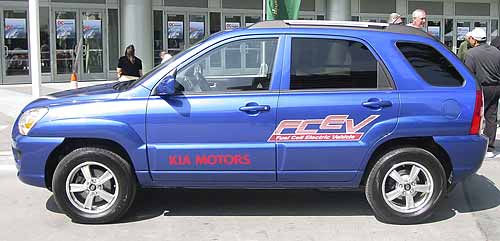 Photo by Hydro Kevin Kantola |
The Kia Sportage FCEV, however, has been one of the show favorites in public ride & drive exhibitions where it has been shown. Unlike it predecessors, the Sportage FCEV’s powerplant is now located underneath the hood, instead of the former under-floor pan installation. Designed for power, cargo capacity and passenger comfort, the Kia Sportage FCEV delivers on all three counts.
For developing the powertrain for the Sportage FCEV, Kia is working in partnership with UTC Power, Enova Systems, Dynetek Industries and LG Chem. The Kia Sportage FCEV contains three compressed hydrogen tanks at 5,000 psi and has a fuel efficient comparable to 57 mpg.
The Kia Sportage FCEV uses a UTC 80 kw PEM fuel cell, a 3-phase AC 80 kw electric motor and tops out at 93 mph. As far as batteries, the Sportage FCEV is equipped with a lithium ion polymer battery rated at 152 v, which adds a little more power during acceleration. The driving range of the Sportage FCEV is approximately 205 miles.
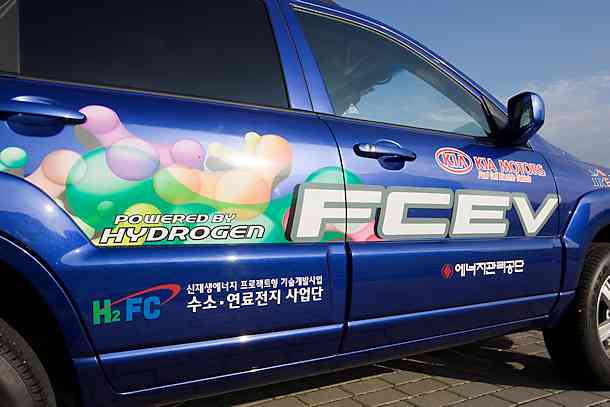
Photo Courtesy Kia Motors
The Kia Sportage FCEV is build using a lightweight aluminum body shell instead of all steal construction in order to reduce the weight to that which approximates a standard Kia Sportage. The Kia Sportage FCEV uses a CVT transmission, which is evidenced by its smooth and powerful acceleration without the clunky shifting of some vehicles.
Much of the development efforts and components, such as the fuel cell, in the Kia Sportage FCEV is also shared by its companion vehicle the Hyundai Tucson FCEV. These two hydrogen vehicles were developed in parallel, yet their components are not identical and they each face separate challenges within the burgeoning hydrogen car market.
Both the Hyundai and the Kia Sportage FCEV are currently being driven at the Alameda-Contra Costa Transit District (AC Transit) in Chino, California.
Assistant Manager at Kia of DTLA, would like info on maybe conversion kit for 2017 Sportage to hydrogen.
Hello Robert, the conversion kits are still considered “experimental” and not something a dealership would want to sell commercially. You may have to wait until 2020. This source says Kia will have a fuel cell vehicle available for sale then. http://www.hybridcars.com/kia-wants-to-launch-500-mile-fuel-cell-vehicle-in-2020/