Hydrogen Fuel Cars 1999
1999 was another short year as only 10 hydrogen cars were displayed in public. Three Hondas, however, were brought forth, the FCX, FCX V1 and FCX V2 making it a good year for this automaker to show off the quick advancement of their new technology.
1999
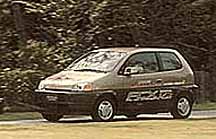 |
The 1999 Honda FCX-V2 uses a Honda-made aromatic 60 kw PEM fuel cell stack and is powered by methanol fuel with an onboard reformer, which extracts the hydrogen. The Honda FCX-V2 also uses a 49 kw electric motor. |
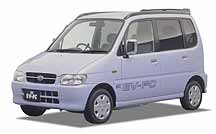 |
The 1999 Daihatsu MOVE EV-FC was the world’s first four-seat vehicle powered by fuel cells in its class. The fuel cell for the Daihatsu MOVE EV-PC was manufactured by the Osaka National Research Institute. The Daihatsu MOVE EV-FC is a hybrid vehicle also uses and onboard methanol reformer and NiMH batteries. |
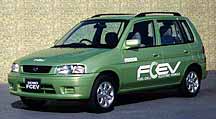 |
The 1999 Mazda Demio FCEV was based upon the 1997 version and made an appearance at the Tokyo Motor Show in 1999. The Mazda Demio FCEV is a hybrid electric vehicle using a 50 kw PEM fuel cell and metal hydride storage technology. |
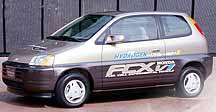 |
The 1999 Honda FCX-V1 uses a Ballard PEM fuel cell and is powered by compressed hydrogen. The Honda FCX-V1 uses a 49 kw electric motor and metal hydride storage. |
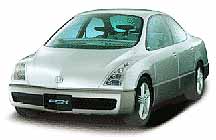 |
The 1999 Honda FCX uses the Twin Solid concept whereby the fuel cell power train is housed in the floor separating it from the cabin. The 1999 Honda FCX use a PEM fuel cell with onboard methane reformer. |
 |
The 1999 BMW 750hL was showcased at the Expo 2000 as the world’s first automobile to run on liquid hydrogen. The BMW 750hL is also a dual fuel vehicle capable of running on gasoline in its 5.4-liter V12 internal combustion engine. |
 |
The 1999 New Jersey Venturer was a converted Geo Metro. The New Jersey Venturer is a hybrid fuel cell vehicle introduced by a consortium of universities, public and private businesses with engineer Mike Strizki as the project lead. |
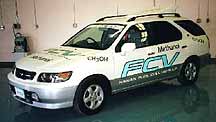 |
The 1999 Nissan Altra FCV is a hybrid electric fuel cell vehicle using a Ballard PEM fuel cell. The Nissan Altra FCV also uses an onboard methanol reformer and lithium-ion batteries. |
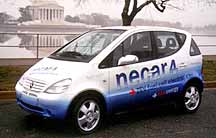 |
The 1999 DaimlerChrysler NeCar 4 is based on the A-Class vehicle and was the first for the company to sandwich the fuel cell underneath the floor. The DaimlerChrysler NeCar 4 runs on liquid hydrogen and uses a 75 kw Ballard PEM fuel cell stack. |
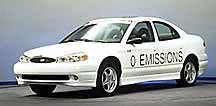 |
The 1999 Ford P2000 FC EV is the world’s first full-size five-passenger fuel cell vehicle. The Ford P2000 FC EV is a non-hybrid model that uses compressed hydrogen gas and a fuel cell from Ballard. |
Navigation
1807-1986 1990-1998 1999 2000 2001 2002 2003 2004 2005
2006-2007 2008-2009 2010-2011 2012-2013 2014-2015 2016-2017
Written by Hydro Kevin Kantola