In the global race to decarbonize transportation, hydrogen fuel cell vehicles (FCEVs) represent a powerful, zero-emission solution. They offer the quick refueling and long range of their gasoline counterparts, emitting nothing but pure water vapor. Yet, for years, a persistent question has shadowed their promise: Where will the hydrogen actually come from?
The most common method today, natural gas reforming, is carbon-intensive. The ideal method, electrolysis powered by renewable electricity, is clean but expensive and demands a massive build-out of renewable energy infrastructure. For a state like California, which is aggressively pursuing both a clean transportation future and ambitious waste reduction goals, this hydrogen sourcing dilemma has been a significant roadblock.
But what if the solution to one problem was literally buried in the heart of another?
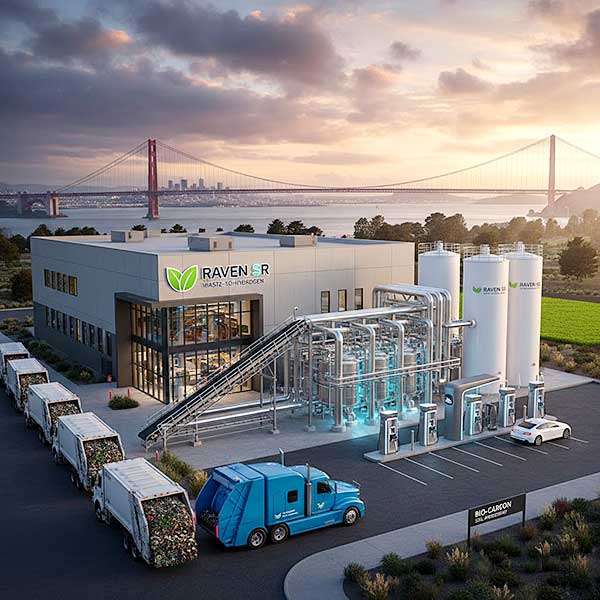
This is the revolutionary premise behind Raven SR, a company that has just received a pivotal green light to transform California’s organic waste crisis into a cornerstone of its clean hydrogen economy. With the recent issuance of the final “Air Permit and Authority to Construct” (ATC) from the Bay Area Air District, Raven SR is set to build the first facility in the state to convert diverted organic waste into renewable hydrogen through a unique, non-combustion process. This isn’t just an incremental improvement; it’s a potential paradigm shift.
The Problem: California’s Dual Crises
To understand the significance of Raven SR’s achievement, one must first grasp the two challenges it simultaneously addresses.
First, there is the hydrogen supply problem. California has committed to deploying over 200 hydrogen refueling stations by 2025 to support the growing fleet of FCEVs from Toyota, Hyundai, and Honda. Producing enough green hydrogen—hydrogen with a minimal carbon footprint—to supply this network is a monumental task. The state needs a reliable, scalable, and truly sustainable source.
Second, and perhaps less glamorous, is the organic waste crisis. In 2016, California passed SB 1383, a landmark law requiring a 75% reduction in the level of organic waste sent to landfills by 2025. When food scraps, yard trimmings, and other organic matter rot in landfills, they release methane—a greenhouse gas over 80 times more potent than CO2 over a 20-year period. Landfills are the third-largest source of methane in the United States. Municipalities are now scrambling for solutions, from composting to anaerobic digestion, but the sheer volume of waste remains a logistical and environmental nightmare.
Raven SR’s technology sits squarely at the intersection of these two crises, offering a compelling and elegant solution.
The Raven SR Process: A Non-Combustion Revolution
The key to Raven SR’s approach lies in its proprietary process, known as Steam/CO2 Reforming. It’s crucial to distinguish this from both incineration and conventional gasification.
Traditional waste-to-energy plants often burn trash, a process that can produce pollutants and is subject to public opposition. Raven SR’s system does not combust. Instead, it uses controlled amounts of steam and oxygen in a sealed vessel to thermally convert organic feedstocks—everything from solid waste and food scraps to green waste and even plastics—into a synthesis gas, or “syngas.”
This syngas is rich in hydrogen and carbon monoxide. From there, well-established purification systems, like Pressure Swing Adsorption (PSA), isolate the hydrogen to the high purity (99.97%) required for transportation fuel cells.
The environmental benefits of this non-combustion pathway are profound:
- Dramatically Lower Emissions: Without combustion, the process avoids the creation of nitrogen oxides (NOx) and other harmful pollutants typically associated with burning. This was a critical factor in the Bay Area Air District’s decision to grant the ATC, as it signifies a cleaner air quality footprint for the region.
- Carbon Reduction, Not Neutrality: By diverting organic waste from landfills, the process prevents methane emissions at the source. While the process does release CO2, its lifecycle carbon intensity (CI) score is exceptionally low. In many analyses, it can even achieve a negative CI score when accounting for the avoided methane, making it one of the most carbon-beneficial fuel production pathways in existence.
- Water Positivity: Unlike electrolysis, which consumes significant amounts of pure water, the Raven SR process actually produces water as a byproduct, which can be recycled back into the system.
The California Facility: A Blueprint for the Future
The permitted facility, to be located at the Republic Services West Contra Sanitary Landfill in Richmond, California, will serve as a powerful proof-of-concept. It will take in a continuous stream of diverted organic waste—the very material the state is mandated to keep out of landfills—and transform it into renewable hydrogen fuel.
This hydrogen will then be supplied to the NorCAL Zero project, which is establishing a network of hydrogen refueling stations for heavy-duty trucks in the San Francisco Bay Area. This creates a perfectly closed-loop system for the commercial transportation sector: waste from communities becomes clean fuel for the trucks that serve those same communities, all with zero tailpipe emissions.
For the State of California, this model is a strategic masterstroke. It creates a new, high-value market for organic waste, providing an economic incentive for cities and waste management companies to comply with SB 1383. Simultaneously, it bolsters the state’s clean hydrogen supply, reducing reliance on fossil-fuel-derived hydrogen and supporting the viability of its FCEV program.
Implications for the Hydrogen and Fuel Cell Vehicle Ecosystem
For those of us who have championed fuel cell technology, the emergence of waste-to-hydrogen pathways is a game-changer. It addresses the most common critique from skeptics: “The hydrogen isn’t even green.”
- Energy Resilience: It decentralizes hydrogen production. Instead of being reliant on a few large, centralized plants, hydrogen can be produced regionally, at or near landfill sites, creating a more resilient and distributed fuel network.
- Fuel Affordability: By creating hydrogen from low-cost, abundant waste feedstocks, Raven SR’s process has the potential to produce hydrogen at a cost that is competitive with, or even lower than, hydrogen from renewable electrolysis, bringing down the total cost of ownership for FCEV operators.
- A Compelling Narrative: The story of a garbage truck or a long-haul semi-truck being powered by the very waste it collects is a powerful and tangible demonstration of the circular economy. It provides a clear, relatable answer to the “where does the hydrogen come from?” question, strengthening public and commercial acceptance.
The Road Ahead
The journey from a permitted facility to a fully operational, scaled network is not without its challenges. Scaling the technology, ensuring a consistent and clean feedstock supply, and navigating local regulations will be the next hurdles. However, the ATC from one of the nation’s most stringent air quality districts is a monumental vote of confidence.
Raven SR’s technology demonstrates that the path to a clean energy future doesn’t always require mining new materials or covering landscapes with solar panels. Sometimes, the most powerful resource is the waste we already have. By seeing trash not as an endpoint, but as a beginning, California is poised to turn its landfill crisis into its clean fuel triumph, paving the way for a future where our vehicles are powered not by ancient fossils, but by the circular, sustainable management of our resources.