Hydrogen Fuel Cars 2004
Hydrogen cars in 2004 also saw a great spurt in development with 15 new vehicles being introduced this year. From the Chinese Chunhui to several Japanese, German and U. S. model, the hydrogen cars showed off exciting innovation this year.
2004
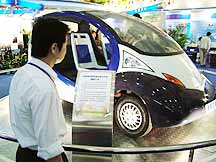 |
The Chunhui No. 3 is a small four seat hydrogen fuel cell hybrid electric vehicle built by Shanghai’s Tongji University automotive college. The Chunhui No. 3 was on display at the 2004 Hannover Faire in the Chinese Ministry of Science and Technology booth. |
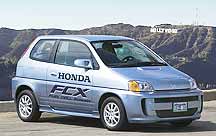 |
The 2004 Honda FCX is a front-wheel drive 78 kw fuel cell vehicle rated at 80 bhp. The 2004 Honda FCX also use ultracapacitors and an AC Sychronous Electric Motor to achieve 51/46 MPGe. |
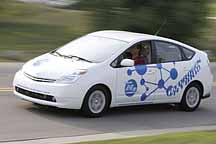 |
The 2004 Quantum Prius was actually a modified 2002 Toyota Prius modified by Quantum Fuel Systems of Irvine, California to run on hydrogen gas. The 2004 Quantum Prius is a hydrogen hybrid electric vehicle with NiMH batteries and two metal hydride storage tanks. |
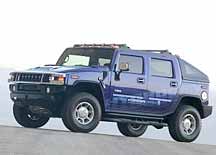 |
The Hummer H2H was rolled out by California Governor Arnold Schwarzenegger at the Los Angeles International Airport (LAX) on October 14, 2004. The Hummer H2H helped LAX open the state’s first retail hydrogen fueling station. |
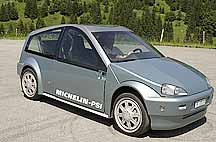 |
The Michelin Hy-Light was unveiled at the Challenge Bibendum 2004 and was built in conjunction with the Paul Scherrer Institute (PSI). The Michelin Hy-Light can accelerate from 0 – 60 mph in 12 seconds with a top speed of 80 mph. |
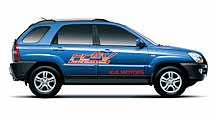 |
The Kia Sportage FCEV is a fuel cell hybrid electric vehicle from Hyundai Motors that uses an 80 kw UTC fuel cell to power the vehicle. The Kia Sportage FCEV employs a lightweight aluminum body shell to cut down on the weight of the vehicle. |
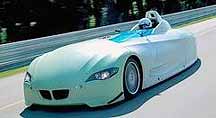 |
The BMW HR2 has set 9 international land-speed records for hydrogen cars. The BMW HR2 uses a dual-fuel internal combustion engine capable of running on either gasoline or hydrogen with the flip of the switch. For the land-speed records the gasoline option was disabled. |
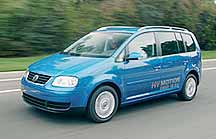 |
The Volkswagen Touran HyMotion uses a Ballard Mark 902 fuel cell and can accelerate from 0 – 60 in approximately 14 seconds. The Volkswagen Touran HyMotion uses a NiMH battery pack and can achieve a top speed of 87 mph. |
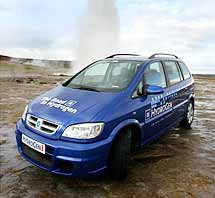 |
The GM HydroGen3 is powered by a 60 kw fuel cell and is based upon the design of the Opel Zafira MPV. With a top speed of approximately 100 mph, the GM HydroGen3 is one of the fastest hydrogen minivans around. |
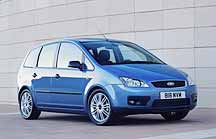 |
The Ford Focus C-Max hydrogen car debuted in Stuttgart, Germany on July 13, 2004. The Ford Focus C-Max hydrogen car is powered by a 2.3-liter, 4 cylinder internal combustion engine with supercharger. |
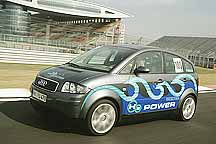 |
The Audi A2H2 combines a Ballard fuel cell with high torque electric motor to fly from 0 – 60 mph in under 10 seconds. With a top speed of 109 mph and a traveling range of 137 miles, the Audi A2H2 is one of the fastest hydrogen car prototypes in recent years. |
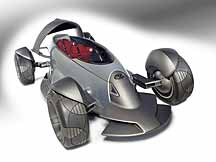 |
The Toyota MTRC (Motor Triathlon Race Car) combines the functionality of an off-road buggy with a racecar. The Toyota MTRC was designed and built at Toyota’s European design studio and is powered by Toyota’s fuel cell stack along with four in-wheel electric motors. Featured in the Gran Turismo 4 video game, the Toyota MTRC was also built for city street circuit races. |
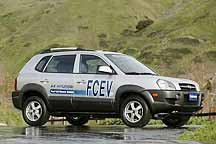 |
The Hyundai Tucson FCEV is a fuel cell hybrid electric vehicle with a driving range of 186 miles. The Hyundai Tucson FCEV is also powered by 80 kw electric motors and lithium ion battery pack. |
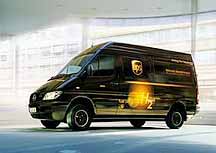 |
Three DaimlerChrysler Dodge fuel cell Sprinters were deployed into service in 2004 in Los Angeles, Sacramento and Ann Arbor, Michigan. The DaimlerChrysler Dodge fuel cell Sprinter vans feature a power increase of 45-percent, a 40-percent increase in range and a 10-percent increase in cargo capacity. |
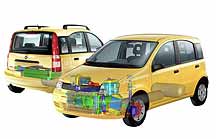 |
The 2004 Fiat Panda Hydrogen is a city car that uses full hybrid power was well as hydrogen fuel cell. The Fiat Panda Hydrogen has a small battery pack that kicks in while accelerating to add extra energy. The vehicle as has a top speed of approximately 80 mph. |
Navigation
1807-1986 1990-1998 1999 2000 2001 2002 2003 2004 2005
2006-2007 2008-2009 2010-2011 2012-2013 2014-2015 2016-2017
Written by Hydro Kevin Kantola