2002
Hydrogen Fuel Cars 2002
The year 2002 was perhaps the most frugal year of the decade for hydrogen car manufacturers with only 10 vehicles shown to the public. Even so, GM was able to show off three hydrogen cars this year along with a rare Chinese vehicle.
2002
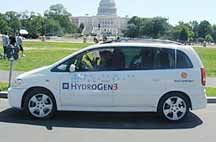 |
The 2002 GM HydroGen3 was announced on December 2 as a joint program between General Motors and Federal Express to test the first commercial fuel cell vehicle in Japan. The GM HydroGen3 has a top speed of 100 mph and a range of 250 miles. |
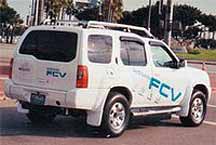 |
The 2002 Nissan X-Trail FCV-3 was unveiled in mid-December after receiving its operating permit from the Japanese government in November of that year. The 2002 Nissan X-Trail FCV-3 uses a UTC fuel cell and lithium-ion battery pack. |
 |
The 2002 GM Hy-wire concept fuel cell car is one of the most futurist cars ever built at this time with its skateboard chassis housing the hydrogen powertrain and a fiberglass body that can be unbolted from its frame and swapped out in 30 minutes. The GM Hy-wire also uses drive-by-wire technology and has a steering wheel that can slide from left to right side depending upon the country it is being driven in. |
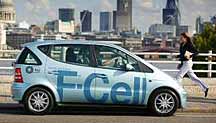 |
The 2002 DaimlerChrysler Mercedes A-Class F-Cell was first presented to the public in October of that year. The DaimlerChrysler Mercedes A-Class F-Cell features a Ballard Mark 902 85 kw fuel cell and was one of the smallest hydrogen cars at that time. |
 |
The 2002 Honda FCX was the first vehicle to obtain U. S. government approval for commercialization in July of that year and in December, five Honda FCX vehicles were leased to the City of Los Angeles. The 200s Honda FCX contained a Ballard fuel cell and Honda’s own high-output ultra-capacitor system. |
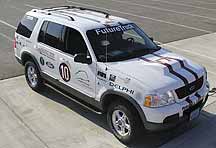 |
The 2002 Virginia Tech Magellan was a modified Ford Explorer XLT for the Future Truck competition. The Virginia Tech Magellan was a hybrid electric vehicle also using a Honeywell 60 kw fuel cell stack given to the university for the competition. |
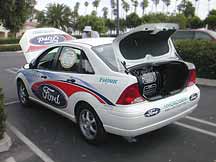 |
The 2002 Ford Focus FCV is a no frills small car that achieved 92 bhp and had a range of around 100 miles. The Ford Focus FCV used a Ballard Mark 902 fuel cell and a compressed hydrogen tank at 3,600 psi. |
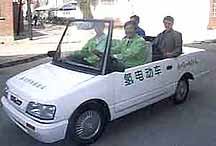 |
The 2002 Green Power Taxi is a fuel cell vehicle presented by the Beijing Institute of Technology in China. The Green Power Taxi had a top speed of 45 mph and was powered by an 18 kw PEM fuel cell. |
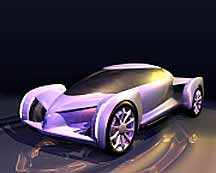 |
The 2002 GM Autonomy was the first vehicle designed from scratch around a fuel cell propulsion system. The GM AUTOnomy was also the first vehicle to combine fuel cell technology with drive-by-wire technology and one of the most futuristic and sporty designs ever for a hydrogen car. |
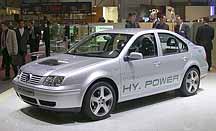 |
The 2002 VW Bora Hy.Power (or Jetta in the U. S.) was a fuel cell vehicle designed by the Paul Scherrer Institute in Zurich, Switzerland. The Volkswagen Bora HyPower used a relatively low-cost 75 kw hydrogen fuel cell coupled with the power of onboard ultra-capacitors. |
Navigation
1807-1986 1990-1998 1999 2000 2001 2002 2003 2004 2005
2006-2007 2008-2009 2010-2011 2012-2013 2014-2015 2016-2017
Written by Hydro Kevin Kantola
Leave a Reply
You must be logged in to post a comment.