Hydrogen-on-demand systems within the automotive industry may one day rock the world. If the current hydrogen on demand systems that are being developed pan out or if future hydrogen-on-demand systems take hold, this could mean that building a huge hydrogen gas infrastructure is not necessary. A hydrogen generator may one day start with just the turn of an ignition key.
This Hydrogen Truck Is For Sale!
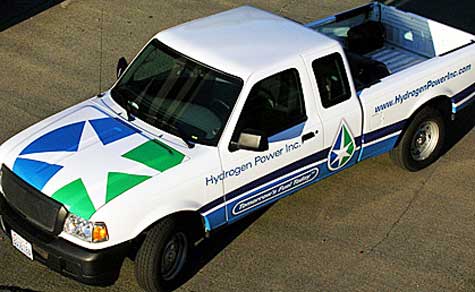 Hydrogen Power Inc.’s Converted 2006 Ford Ranger XL |
Currently, the hydrogen-on-demand systems that are being developed for the automotive industry either use electrolysis or a chemical reaction in order to generate hydrogen fuel as needed for a car equipped with either an internal combustion engine (ICE) or a fuel cell. The hydrogen-on-demand systems that use electrolysis generally use some other metal catalyst such as aluminum or magnesium to help aid in the process.
The hydrogen-on-demand systems that use a chemical reaction usually start with sodium borohydride (or another boron / hydrogen derivative), which is a hydrogen-rich chemical compound and force a reaction that releases the hydrogen as needed. In the case of sodium borohydride (NaBH4), the result of the chemical reaction is to degrade into inert salt, which can then be recycled back into sodium borohydride again.
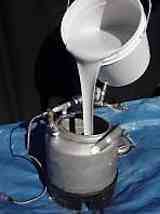
Hydrogen Slurry
Some of the companies currently developing hydrogen-on-demand technology include Hydrogen Power Incorporated, who have developed a Hydrogen Now system, which they have demonstrated at the 2007 International Auto Show in Seattle, Washington. The Hydrogen Now system was retrofitted inside a 2006 Ford Ranger XL. Another company that currently has a retrofit hydrogen insertion device on the market, Hypower Fuel Incorporated is testing its new Hydrogen Reactor (H2R) on-demand system and is expected soon to demonstrate its device.
HyPower Fuel has also teamed up with scientists and researchers from Middle Tennessee State University to produce a plug-in hybrid electric flex fuel vehicle that uses hydrogen on demand technology. Dr. Clifton Ricketts is leading the project and expects to be able to develop a racecar using this same technology that will be run at the Bonneville Salt Flats in Utah.
Ecotality out of Scottsdale, Arizona is developing its Hydratus system to power a bus using a combination of magnesium and water. Ecotality and is expecting a bus tour demonstration sometime in the latter part of 2007.
UPDATE: Ecotality is no longer working on hydrogen projects and instead is one of the leading supplier of EV charging stations in the United States.
In 2002, the Duffy fuel cell boat made waves by testing out a hydrogen-on-demand system developed by hydrogen battery maker, Millennium Cell. The boat also was equipped with a fuel cell. The hydrogen-on-demand Duffy boat used borax as its source for sodium borohydride to power the vessel. Millennium Cell also demonstrated its hydrogen-on-demand systems in the 2001 DaimlerChrysler Town & Country Natrium and the Peugeot-Citroen H2O concept vehicles.
Millennium Cell has a 5-year $3 million contract with the Department of Energy to continue research on sodium borohydride technology. Millennium Cell is also working with the Los Alamos National Lab and Dow Chemical on methods to lower the cost of manufacturing the chemical compound.
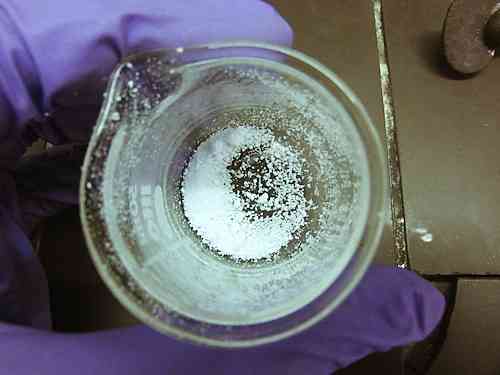
Sodium Borohydride
Samsung Engineering has also developed a prototype scooter that uses sodium borohydride for its hydrogen-on-demand applications to power the vehicle.
So far, hydrogen-on-demand technology has not gained much attention but the implications of such technology are immense. One day in the future, it might just be that the Big Chemical companies are fighting with the Big Oil companies over who will be fueling the nation’s cars. Wouldn’t this be interesting?
Written by Hydro Kevin Kantola
i want to get the car but i want to be sure about something. those the car run on water on if i buy it or it run on half on water n half on water
Hello, Edward, the cars that run on gasoline and supplement with hydrogen generators (hydrogen from water) are still considered experimental. As they say, “Your mileage may vary.” Here is some more info about them.
https://www.hydrogencarsnow.com/index.php/hydrogen-generators-for-cars/
NeahPower Systems has developed a hydrogen on demand system using formic acid. It is a registered trade mark as FormiraHOD.
Have you ever heard of this?
Hi Paul, yes I’ve heard of it. Here is more info: http://neahpower.com/wp-content/uploads/2015/10/Formic-Acid-Hydrogen-Reformer-for-Fuel-Cells.pdf