Ford has done it again with its Flexible Series Edge SUV with HySeries Drive, another plug-in hybrid hydrogen vehicle from this automaker. The hybrid Edge further advances the real-world drivability not found in the Ford Airstream Concept that was rolled out earlier the same month at the 2007 International North American Auto Show in Detroit.
|
|
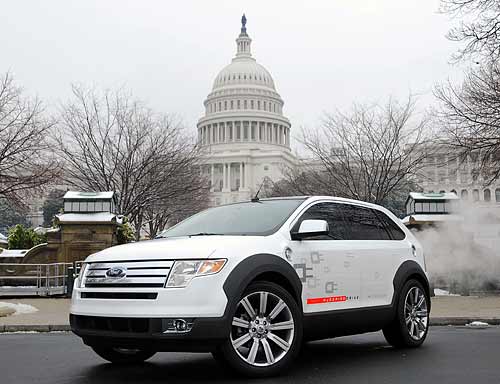
The Ford Flexible Series Edge is a plug-in hybrid electric hydrogen fuel cell vehicle (PHEH2FCV) that uses the same HySeries Drive system as the Ford Airstream, yet is packaged inside a standard Ford Edge crossover body.
The Ford Flexible Series Edge was rolled on January 23, 2007 during the Washington DC Auto Show, just before President Bush’s State of the Union Address, which addresses the concerns of the North American automakers. As a plug-in hybrid electric vehicle (PHEV), the Ford Flexible Series Edge can run the first 25 miles entirely on battery power.
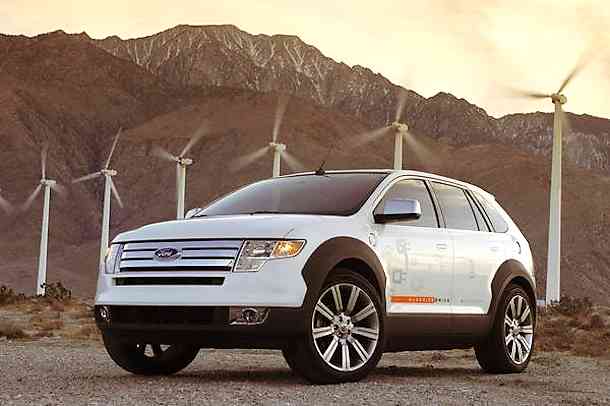
Once the battery is 40-percent depleted, the Ballard fuel cell kicks in and recharges the 336-volt lithium ion battery pack, which in turn supplies current to the electric motor to drive the wheels. The 5,000 psi hydrogen tanks and fuel cell add 200 miles to the vehicle’s range for a total of 225 miles when combined with the battery pack.
 |
This range is somewhat deceiving, however, as it may vary widely by individual driver and driving habits. |
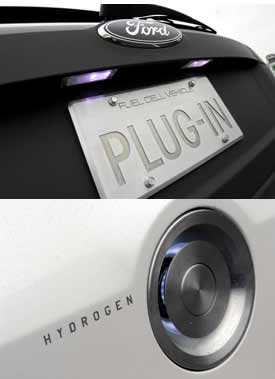
For instance, someone who drives only 25 miles per day will be able to drive on battery power only and recharge the battery pack at night for 8 hours with a 110-v or 220-v outlet before doing the same thing the next day. Those who drive 50 miles per day will receive the equivalent of 80 mpg. Those who drive the entire range of the vehicle in one day will get a combined city / highway mileage of 41 mpg. The Ford Flexible Series Edge can reach a top speed of 85 mph.
The “flexible” part of the Ford Flexible Series Edge is that the fuel cell can be easily removed and replaced with a downsized gasoline or diesel engine. With this plug-in Ford Edge, the fuel cell size, weight and cost have been reduced by half and by using this type of hybrid system, the life of the fuel cell will be double the life of other fuel cells.
Lithium-ion battery technology remains a significant cost hurdle, however. Both Ford and General Motors have asked the Federal Government for as much as $500 million for additional research and development on lithium-ion technology in order to bring the costs down within the next couple of years.