EERC Says Hydrogen Cars Ready in 4 to 5 Years

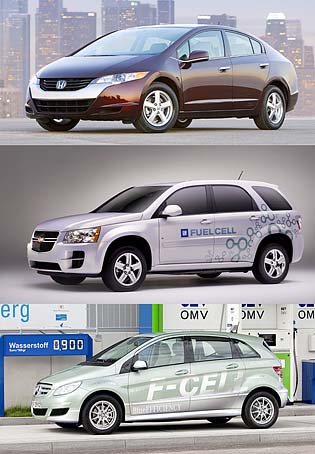
Since I had talked about timelines yesterday for rolling out hydrogen cars and how the critics want to drag this process out for decades, I thought I would follow up today with a short timeline from a hydrogen advocate. According to Dr. Gerald Groenewold, the Director of EERC (Energy & Environmental Research Center) at the University of North Dakota, hydrogen cars could be commercial available in as little as 4 to 5 years.

According to Dr. Groenewold, “Hydrogen is not the fuel of the future-it is the fuel of today! Depending on the world’s energy situation, certain fuel cell vehicles could be commercially available in 4-5 years. We have the technologies to move forward with hydrogen as a viable fuel, but we lack the commercial infrastructure to make it available to everyone.”

EERC is also home to the NCHT (National Center for Hydrogen Technology) that is in charge of $60 million in pending or current funding for hydrogen research. Some of the other interesting ventures that EERC is developing include hydrogen from biomass, jet fuel, wind energy and ethanol.

EERC has teamed up with the Chippewa Valley Ethanol Company out of Minnesota to develop low cost hydrogen from ethanol in one of its production plants. Using a high-pressure reforming process and wet, undenatured ethanol, large quantities of hydrogen can be produced in a financially prudent manner.

So, no matter who you ask about hydrogen cars, the timelines can vary by decades. But, if there is social will and political will there is a way. And, hydrogen may just weigh in a lot sooner than most everyone thinks.

Hydrogen Car Timelines Confuse Rather Than Enlighten

Hydrogen car timelines have always amused me to some degree. It seems like everybody and their mother wants to weigh in and predict a date that hydrogen cars will roll off the assembly lines en masse.

Advocates such as myself, predict a short timeline and timeframe (such as 5 years) with the caveat that there must be enough public outcry and political will to make this happen. Critics of hydrogen cars will generally pick a long timeline such as the year 2050 because they don’t see the political will or see too many antagonistic forces at work for a shorter timeframe.

A few years ago, companies like GM and Honda said they would be ready to roll cars out in mass production by 2010. This timeframe has slipped a bit to 2012 – 2015 simply because there will be no significant fueling station infrastructure in place by 2010.

By 2015, Mercedes-Benz has stated that it plans to get rid of their gasoline powered vehicles in favor of alternative fuel vehicles including those powered by hydrogen. According to Science Daily there could be 2 million hydrogen cars on the road by the year 2020.

This is good news since according to General Motors, once 1 million hydrogen cars are on the road, they will be cost competitive with standard gasoline-powered vehicles because of economies of scale. To give some perspective, the Toyota Prius just crossed the 1 million sales mark this year.

News agency Reuters quotes the National Research Council as saying that hydrogen fuel cell cars are still 15 years away (the year 2023) from being viable technology. This is due to the infrastructure that needs to be built or the high cost of platinum that I had talked about yesterday.

The Green Fuels Forecast looked at the same National Research Council study and came up with the date of 2030 for hydrogen cars to be viable. Their thinking was that 25 million fuel cell vehicles would be on the road by this date.

An article in Lubbock Online looked at the exact same study and put the date out to 2050 as when hydrogen cars would be competitive with gasoline-powered vehicles. Each of these last three resources picked out a part of the study’s timeline that suited their needs and viewpoint.

But, the aspect about predicting the future is that one is often wrong in making such predictions. New technological breakthroughs, new social, economic and political developments and new ways of thinking often change the foretold pathways. As Yogi Berra once said, “If you come to a fork in the road, take it.” For hydrogen, there will be many forks ahead that will change the future transportation landscape and these will be the kinds of forks no one will be able to predict ahead of time.

Platinum for Fuel Cells to Come From Catalytic Convertors?

One of the arguments that critics of hydrogen cars launch is that the cost of platinum for fuel cells is too high. The critics not only state that the high cost of platinum means fuel cells are too expensive, but that going to a fuel cell based automotive economy would lead to a world wide shortage of platinum.

But, what the critics fail to state is that we are already using platinum inside our internal combustion engine vehicles inside the catalytic convertors. Many catalytic convertors also use the precious metals of palladium and rhodium as well, which are also common in some models of fuel cells.

What this means is that as more gasoline-powered vehicles are replaced by fuel cell vehicles, the out-of-commission catalytic convertors can be used as a source of platinum and other precious metals that can be recycled for the building of additional fuel cells. Right now, platinum in catalytic convertors is being recycled for the building of additional catalytic convertors.

The recycling of catalytic convertors for fuel cells will most likely be a short term process as well. Many fuel cell manufacturers employing nano-technology are using less platinum than ever before. Other manufacturers are using non-precious metals or even non-metal alternatives to platinum as the catalysts in the fuel cells, bringing down prices significantly.

Expect this trend to continue in the quest for every cheaper fuel cell technology. But, in the shorter term, one solution for supplying platinum for your fuel cell car is right inside your gasoline-powered car. The passing of the torch from one energy paradigm to the next may just be titled, “Who Killed the Catalytic Convertor?”

GM Project Driveway Tester Asks for More H2 Fueling Stations

Daniel Krach of Newport Beach, California was lucky enough to get behind the wheel for three months in a Chevy Equinox Hydrogen fuel cell vehicle. In fact, Krach refuels his vehicle at the UC, Irvine campus at the same location that I took a page full of photographs a year and a half ago.

According to Mr. Krach, he felt a bit shackled by the lack of familiar H2 fueling stations as he had yet to be trained on the refueling process until several days after accepting the keys. In addition, Krach had to cut short a visit with a friend in Los Angeles in order to make it back to the Irvine station with only three miles to spare on the compressed hydrogen tank.

I drove this same vehicle a couple of years ago and agree that it is quiet with plenty of power compared to other similar hydrogen vehicles. The trouble Mr. Krach was having was not with the Chevy but with locations of the six semi-private hydrogen fueling stations in the Los Angeles and Orange County areas that were not open all hours. Fortunately, Mr. Krach says he only lives a couple of miles from the UC Irvine station that is on the corner of Jamboree Blvd. and Campus Drive, and is open 24 / 7.

According to Krach, “But the way I see it, the key is to start building those hydrogen filling stations - now. With the experience I’ve had driving this vehicle these past few weeks, I’m eagerly awaiting the day I can buy one. But I certainly don’t want limitations on how far I can go.” And, GM VP Larry Burns is in agreement, since in April 2008 he said regulators were to blame for the slow rollout of hydrogen refueling infrastructure.

And, such goes the Achilles heal of the hydrogen car rollout. If political consultant James Carville were trying to get hydrogen vehicles elected as the next zero-emission car of choice in this country, he may say something like, “It’s the infrastructure, stupid.” This would be the major point we need to focus our time, energy and attention upon and make sure that our candidates are onboard with this same vision as well.

Can Hydrogen and CNG Be Companion Flex Fuels of the Future?

Even before T. Boone Pickens announced his plan for the U. S. to switch over to wind energy and CNG-powered cars, I have been contemplating how compressed natural gas could be used to transition over to the hydrogen economy. In fact, in March 2008 I had written that in California alone there were eight times as many CNG stations as there were hydrogen fueling stations and these could be used for the transitional efforts.

But, recently I’ve had a few thoughts about how hydrogen and CNG can be “companion” fuels for a while occupying the same vehicles at the same time, but in two different ways. The first scenario is a dual fuel (or flex fuel) vehicle and the second scenario is in a mixture of these two gases running the same vehicle.

In regard to the flex fuel scenario, Tai Robinson of Intergalactic Hydrogen talks in this video about his vehicle that is powered by both hydrogen and CNG using separate tanks in the rear of the truck. Robinson speaks about how he can refuel his vehicle in Utah with natural gas drive it to Las Vegas where he can fuel up the other tank on hydrogen and drive on to California where he can choose either hydrogen or CNG or both to fuel up the vehicle depending upon the needs of the truck and price at the pumps.

The dual fuel hydrogen and CNG scenario offers the consumers choice and flexibility along with the ability to scout for the lowest prices at the refueling stations. In addition, if this nation were divided on which alternative fuel to build the infrastructure for and decided on a minimal infrastructure for both hydrogen and CNG, then drivers could still travel long distances knowing that either fuel (or both) will be available to them.

In regard to the second scenario of mixing both hydrogen and CNG gases in a blend, this is the game plan for India right now. In September 2006, I had talked about how New Delhi was opening a refueling station that dispenses pure hydrogen, CNG and a mixture of both called HCNG. A mixture of just 10-percent pure hydrogen with CNG will require no engine modifications to CNG-powered vehicles and will reduce emissions by 30 to 40-percent from vehicles running CNG only.

Right now over 90-percent of the hydrogen produced in the U. S. is from steam reforming of natural gas because of the high H2 content in this fossil fuel. The Standing Committee on Emission Regulation in India has just approved the mixture of CNG with 20-percent pure hydrogen. When this is ratified, shortly, India will be the first country in the world running an H2 and CNG blend commercially.

Steve W. and Hydrogen Conversion Kits - Part 2

In part one yesterday, Steve W. talks about partnering up Pep Boys with Intergalactic Hydrogen to sell H2 conversion kits for ICE vehicles nationwide. In part 2, Steve gives more detailed plans about his vision for the hydrogen fueling station and considers ITM Power as a potential supplier of that station.

Steve W.: What I’m looking for in a hydrogen refueling station that I can present to Pep Boys, whether it be one that can be publicly accessible at Pep Boys’ automotive service centers or sold through their retail outlets for private home usage, is one designed so that it takes in rainwater from the sky, and through the electrolysis method, acquires the electricity it needs to run an electrical current through the water to produce the hydrogen, from wind and/or sun.

Such a station could give us the full assurance that no out-of-sight/out-of-mind trade-offs are occurring. It is not just a matter of making hydrogen fuel as inexpensive as possible, though I certainly hold that as a major goal, but to come up with a means of producing hydrogen that we absolutely know can be sustainable indefinitely (so long as there’s rain and sun and/or wind), and is not resulting in any sort of out-of-sight/out-of-mind harm anywhere else, whether to the natural environment or to innocent people.

Anyway, I have an image in my mind of what I want to go to Pep Boys with. But, coming up with that is the hard part. In its simplest form, in terms of the hydrogen refueling station I would like to present, I picture a large cylindrical shaped device with a large funnel on top, the latter for taking in rain water. Just underlying that funnel I picture a rotating collar with vertical blades, what can be described as a turret-style wind turbine, and of course it rotates in accordance with the speed of the wind. Right below that are two cylindrical-shaped tanks stacked atop one another.

The upper one contains the hydrogen that the device produces (since hydrogen is lighter) and the lower one contains water. The funnel at the top of the device has a narrow shaft that leads straight down to and refills the water tank at the bottom. And right around that shaft in the vicinity of the rotating collar is a smaller, collar-like generator powered by the outer collar, which in turn produces the electricity that is then run through the lower tank to produce hydrogen.

Insulted wires run from this generator down the shaft through the hydrogen tank into the water tank where the wires then feed a battery positioned in the lower tank. And from this battery there are wires running through the lower tank that are fully exposed to produce the hydrogen. And the hydrogen that is produced as a result of this then uni-directionally enters into and fills the upper tank. And attached to the upper tank is an outer hose by which hydrogen-powered vehicles can be refueled.

And rather than anything within the upper tank pressuring the hydrogen out, the hydrogen is absorbed from the upper tank by the type of onboard storage the vehicle uses. Or it could be that heat is used within the fueling station’s upper tank to release the hydrogen from the device’s upper tank through the hose to the vehicle. In that case, something would be needed to heat the device’s upper tank. And perhaps the wind generator could provide the electricity needed for that as well. But all told, as you can see, what I’m envisioning here is a little bit tricky, but not all that complicated really.

Thanks again for your link telling me of the latest breakthroughs being made by ITM, which has me now considering if it is they who I should get in touch with next regarding something I can go to Pep Boys with.

So now the question is what about ITM? Is ITM ready with anything that can begin to be mass-marketed and that I can go to Pep Boys with? ITM seems to have really made tremendous strides with developing hydrogen fueling stations ready for this. But what about when it comes to training Pep Boys’ mechanics to convert vehicles so that they can run on hydrogen? For without cars that can run on hydrogen, what good are the hydrogen refueling stations?

But, I could picture, if the service were to suddenly be offered at the mass-market level, millions of Americans taking their existing vehicles to wherever they could to have them altered so that they could run on hydrogen, so long as they can be assured of having ready access to hydrogen fuel. And, of course, if they can have the assurance that it’s not just a passing fad.

Many thanks to Steve W., the H2Revolutionary for taking the time to email me his detailed plan including his past contacts with Pep Boys, Intergalactic Hydrogen and the oil companies and his attempts to get the ball rolling in regard to H2 conversion kits for everyone who wants one. It is through these grassroots efforts that the hard work will be done before enough idea bulbs pop above the top level executives’ heads who make the decisions to make a big and bold move regarding the hydrogen marketplace.

Steve W. Wants Hydrogen Conversion Kits in Pep Boys Now – Part 1

Steve W. (aka H2Revolutionary) and I have been trading a series of lengthy emails for the past couple of weeks or so. I thought it was time to share some Steve’s thoughts about the future goal of getting hydrogen conversion kits for ICE vehicles inside all of the Pep Boys stores nationwide.

My apologies first to Steve W. for cutting down some of his long, eloquent and thoughtful emails into the bare essential excerpts in order to fit into the space in this blog and then breaking it over two days.

Steve W.: “The Pep Boys Corporation, which maintains its main headquarters in Philadelphia, Pennsylvania but has automotive service centers located all throughout the continental U.S. and Puerto Rico, is the only automotive service center chain at the present time that could put a hydrogen I.C.E. economy in place all throughout the continental United States and Puerto Rico in a very rapid period of time.

Back in the spring of 2004 I caught an exciting episode of Scientific American Frontiers on PBS called “Future Car,” which brought to my attention the powerful potential of hydrogen as the ultimate means by which cars of the future will be powered.

After seeing the program I then got in touch with Pep Boys Corporation, which has its headquarters here in Philadelphia, to see if by chance they were set up to alter cars to run on hydrogen via the hydrogen I.C.E. method … then got a call back from one of Pep Boys’ executives, it might’ve been Larry Stevenson, who was Pep Boys CEO at that time … In any event, he told me Pep Boys’ service centers were not offering the service at that time, but he said he liked the idea and would run it through the Pep Boys ‘think tank.’

Of the small hydrogen start-up companies I researched, I finally settled on Intergalactic Hydrogen (based in Utah) and headed up by the father & son team of Fred & Tai Robinson as holding the most credibility. For not long before, they had demonstrated a Hummer they had converted to run on hydrogen for Arnold Schwarzenegger who was running for governor of California at that time. I even put together a very basic business plan.

The essence of this business plan is simply to establish a mutual relationship between the Pep Boys Corporation and Intergalactic Hydrogen. There is nothing complicated or non-implementable about this business plan whatsoever.

What we need is a start-up hydrogen technology company that’s specifically set-up to take raw ideas and turn them into finished products, that then can be mass-marketed in a very uniform sort of way. They don’t necessarily have to be a well-established company such as Ballard Power or Energy Conversion Devices just so long as they can prove to Pep Boys itself what they have is good and solid. And if they can do this, Pep Boys, through its mass-marketing of their goods and services, can give them the credibility they need. For I feel the general consensus is, if Pep Boys is selling it, it must be okay.

I see that T. Boone Pickens is appearing all over the place promoting CNG as the new savior, while the more I learn about natural gas the scarier it gets. If the hydrogen economy could be launched in a big way in a hurry all this could be avoided. And I couldn’t even begin to suggest how this could be possible without Pep Boys and the tremendous potential I feel it holds being put front and center on the table.

However, that said, the hydrogen package it would mass-market would have to be pretty solid. As in, we will convert your car to run on hydrogen at a cost of $900 or less and we will warranty our work for a period of at least 10 years backed up by our skilled, trained mechanics, we will provide hydrogen fuel at low cost at all our automotive service centers throughout the continental U.S. and Puerto Rico, plus, we will sell home-producing hydrogen fuel systems through all our retail outlets so that hydrogen fuel can be produced at home, all backed up by Pep Boys’ longstanding good reputation.

Incidentally, with Sunoco being Philadelphia-based, I got in touch with them several years back to ask if they had any plans of producing hydrogen fuel, thinking that could be an angle to take the Pep Boys idea further — that is, creating a joint venture between those two Philadelphia-based corporations — but it was absolutely a no go. Not only did they not have any intentions of producing hydrogen fuel as an extract of that which they now produce, but they were infuriated at just my mere mention of the word hydrogen.

As for Texaco, given how they have service garages all over the U.S. as well as filling stations, I did suggest to them that they could take on the role I was urging Pep Boys to do — of offering the service of converting customers’ vehicles to run on hydrogen plus providing hydrogen fuel. But unlike Pep Boys and Sunoco, of course, as a refiner, it is tied directly to Big Oil. It meets face to face and has the strongest of all bonds with those who produce petroleum.”

This concludes part 1, so check back again for part 2 of Steve’s Journey to get H2 kits into Pep Boys and mainstream this technology.

HHO Gathering at Woodley Park in Van Nuys, California

HHO gatheringOn Saturday, July 12, 2008 there was an HHO gathering in Van Nuys, California at Woodley Park where several vendors and consumers showed up to talk about hydrogen on demand for their vehicles. A fellow named Carl W. had emailed me about this event on Friday that he planned on attending the next day as he wanted to check it out to see if it was real or not.

I heard back from Carl over the weekend and he has reported that the event was indeed real and helpful and the attached photographs of the event are courtesy of Carl W. (so many thanks Carl!). Carl stated that even several mechanics were on hand to help talk to consumers about the installation process of these HHO kits.

According to Carl, there were about 15 vendors at the event selling their hydrogen generators for cars for between $150 and $600 depending upon the manufacturer. Several HHO kits seemed professionally presented along with some other functional kits that were more for go than show.

The HHO Gathering kicked off a noon and Carl stated a man named Ozzie (known for his Water4Gas HHO eBooks) seem to be behind organizing the event. Refreshments and cold drinks were also to be had at this venue.

In April 2008, I had talked about the 2008 Hydrogen Booster Rally, the first of its kind, coordinated by Larry Jarboe taking place from Maryland to the Florida Keys and back. This was the first HHO event that had showed up on my radar (another rally is planned for the Fall this year).

HHO Woodley ParkNow, with the HHO Gathering in Van Nuys, California it looks like the hydrogen on demand industry has gone bicoastal. As word catches on (like it surely will) one can expect more of these workshops, gatherings, rallies and other venues to be popping up nationwide. It’s only a matter of time until the average consumer will take notice of HHO generators as a way to reduce gas mileage and thumb their noses at those selling foreign fossil fuel.

Hydrogenics Supplies Fuel Cell and Electrolyzer to Univ. of Glamorgan

Hydrogenics HyPMHydrogenics Corporation will be supplying a HyPM fuel cell and HySTAT-10 electrolyzer unit to the University of Glamorgan in Wales for a research demonstration project. The HySTAT-10 electrolyzer will be powered by wind turbines as its renewable energy source.

Air Liquide Group will be overseeing the project to install the Hydrogenics equipment at the Glamorgan Renewable Hydrogen Research and Demonstration Centre. The hydrogen created by the new installation will be used to refuel both a fuel cell shuttle bus and delivery van.

Talking about both Hydrogenics and the University of Glamorgan has been a favorite subject of mine in the past. For instance, just two days ago I had talked about the ITM Power home refueling station and mentioned Hydrogenics as well. In September 2006, I had talked about how Hydrogenics was developing a hydrogen fueling station along with GM and Honda. And, in December 2007, I had talked about how Hydrogenics was selling one of its HySTAT-30 stations to Ford for refueling its Focus FCV.

Past topics about the University of Glamorgan include their development of a fuel cell ferryboat and the fuel cell minibus I’ve already mentioned above, which will cost far less than most present day fuel cell cars.

The pairing of Hydrogenics and the University of Glamorgan is a natural fit to combine research along with real world practical knowledge and demonstration of technology that will shape the future. Now, if we can just get one of those ITM Power hydrogen fueling stations to the University, this will be another complimentary partnership that will give street cred to putting H2 into the home as well as classroom.

T Boone Pickens Picks Natural Gas Over Hydrogen

T. Boone Pickens is an oilman, a gas man and a wind man. After 60 years as an oil tycoon with a net worth estimated at $3 billion, T. Boone Pickens no longer wants to be an oilman, but one who is powered by gas and wind (insert your own joke here).

According to the newly unveiled Pickens Plan, T. Boone is choosing natural gas and wind power as the solution to the U. S. $700 billion per year imported oil habit. In a recent Wall Street Journal article, the oil tycoon calls the U. S. wind corridor from Texas up to Canada, the “Saudi Arabia of the Wind”.

Pickens says the town of Sweetwater, TX was revived by a 2,000 MW wind farm and that he is building a 4,000 MW wind farm in Pampa, Texas, which will be the largest in the world of its kind (he saying goes that everything is bigger in Texas).

The basic theory behind the T. Boone Pickens energy plan is to use wind energy to replace natural gas powered electric plants that currently account for 22-percent of the energy in the U. S. nationwide (and higher in California). This “extra” domestically-produced natural gas can then be used to power cars such as the Honda Civic GX CNG vehicle.

Pickens says this plan will be a bridge for electric cars and hydrogen fuel cell cars in the next 20 to 30 years. Now, I have no problem with Pickens’ wind energy plan. I believe this nation should be going Gung Ho on wind, solar, hydro, geothermal and every other clean, renewable energy source we can get our hands upon.

The problem I have is with using intermittent wind energy to free up natural gas for CNG vehicles as a bandage for the next 10 to 30 years until hydrogen cars are ready to go. The fact is that hydrogen cars are just about ready to go now. The only thing holding back hydrogen cars is the infrastructure.

If the idea is to use the minimal natural gas fueling station infrastructure that exists now and build upon this nationwide to support millions of vehicles, then it makes sense to me that this would be the ideal time to go to hydrogen instead. Today, over 90-percent of the hydrogen created in this country is made by steam-reforming of natural gas. This “extra” natural gas that wind power will free up can be used to create hydrogen for fuel cell cars, which are more than twice as efficient as today’s gasoline-powered vehicles and more efficient than natural gas internal combustion engines as well.

In March 2008, I had talked about how the current CNG infrastructure for cars can be transitioned to be used for hydrogen fuel cell cars. I still believe this to be true.

I’m also not the only hydrogen advocate taking issue with the Pickens plan. In May 2008, Greg Blencoe of Hydrogen Discoveries was picking a bone with T. Boone Pickens over this issue and yesterday, Greg also made a post outlining the seven problems to the Pickens energy plan.

Now that I’ve railed on a bit, here is what I would like to see. First, since Pickens’ Mesa Power LP has decided to buy hundreds of wind turbines from General Electric for use in the Texas panhandle and Oklahoma, I would like to see the extra energy delivered by these wind farms stored as hydrogen. This extra hydrogen can be both sold for use in cars and used in stationary fuel cells to supply energy back to the grid to smooth out the intermittent quality of this type of electrical generation.

Second, I would like to see that the natural gas that is freed up from using wind, solar, geothermal and other renewable resources be used to create hydrogen for fuel cell cars and not CNG vehicles. The time is now to make this leap in technology and not delay it with a vast series of growing pains over many decades. All in all, the Pickens plan does have merit. It just needs a little tweaking in the right direction and some political will to make hydrogen cars a reality now.