HyFLEET: CUTE
HyFLEET: CUTE is a European project that is comparing the advantages and disadvantages of hydrogen internal combustion engine (ICE) buses with fuel cell buses.
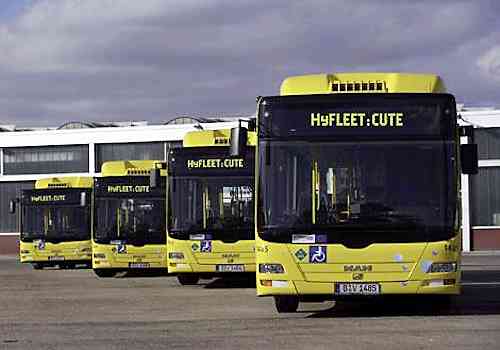
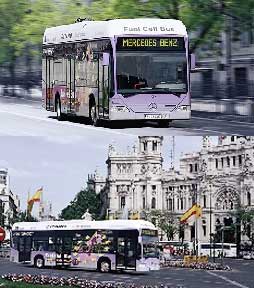 HyFLEET CUTE Bus |
CUTE stands for Clean Urban Transport for Europe and the goal of the project is to test and demonstrate hydrogen buses in 10 different cities in Europe, Asia and Australia to reduce CO2 emissions and move away from fossil fuels. |
HyFLEET: CUTE is based upon the information garnered from three other projects, CUTE, ECTOS (Ecological City TranspOrt System) and STEP (Sustainable Transport Energy Project). ECTOS was a fuel cell bus program based in Reykjavik, Iceland and STEP was a fuel cell bus program based in Perth, Australia.
The ten cities currently involved in the HyFLEET: CUTE project include: Reykjavik, Iceland; Perth, Australia; Beijing, China; London, England; Amsterdam, The Netherlands; Luxembourg, Luxembourg; Madrid and Barcelona, Spain; Hamburg and Berlin, Germany.
Berlin, Germany has been designated by the HyFLEET: CUTE project as a location of the largest supporting infrastructure for the hydrogen bus fleet. The filling station in Berlin will be equipped to supply both compressed gaseous hydrogen and liquid hydrogen and will be able to refuel 20 hydrogen buses or 200 hydrogen cars. The Berlin hydrogen fueling station will also use new ionic liquid technology instead of pistons to compress the hydrogen gas to achieve greater psi than previous compressors.
Hydrogen produced for the HyFLEET: CUTE will come from many different sources both renewable and non-renewable. The renewable generation of hydrogen will include hydrogen produced by solar, wind and geothermal. The non-renewable sources will include hydrogen produced from natural gas, LPG (Liquefied Petroleum Gas) and Bio-DME (Bio Dimethyl Ether).
One of the major goals of HyFLEET: CUTE is to demonstrate that both fuel cell and ICE buses can be cost effective alternative currently in operation. Comparisons will be drawn between the hydrogen buses and those that run on either diesel or CNG (compressed natural gas). Fuel cell buses in the HyFLEET: CUTE fleet are to remain in operation for 12 hours a day with a minimum operation of 4,000 hours per bus.
This will give a good indication of real life testing of the life cycle of hydrogen buses. These life cycle assessments (LCA’s) will be used to analyze environmental impact and energy efficiencies among the different types of buses used. The well to wheel analysis will be used to improve efficiencies in the overall process of hydrogen production and transportation and the development of future hydrogen buses.
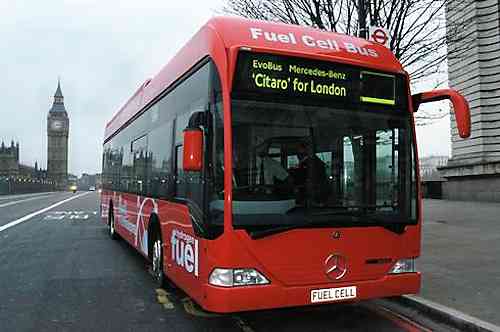
Three of the fuel cell buses currently being tested in the HyFLEET: CUTE project include the Mercedes Benz Citaro Fuel Cell Bus, the Man Lion’s City H 150 kw model, and the Man Lion’s City H 200 kw model. A few other bus models also exist such as the liquid hydrogen hybrid bus running in Berlin.
Note: the HYFLEET: CUTE project has now come to an end. It has been replaced by the CHIC (Clean Hydrogen In European Cities) project which calls for the full scale commercialization of hydrogen powered vehicles.
Written by Hydro Kevin Kantola