Home
Hydrogen Cars Now
Some say hydrogen cars are the future, but in reality they are here now (just ask Hyundai and Toyota). When H2 cars become the status quo, the U. S. can lessen its dependence upon foreign oil, achieve lower prices at the fuel pumps and cut down on the greenhouse gases that produce global warming.
RECENT BLOG POSTS
- Caffeine Makes Fuel Cells (and Myself) Perform Better
- 2025 Honda CR-V Fuel Cell Review
- Harnessing the Power of Dirt: A Revolutionary Fuel Cell for Sustainable Sensing
- NamX Hydrogen Car Review
- Honda Shows Off Its CR-V Hydrogen Fuel Cell Module
- Comparison: 2024 Hyundai Nexo vs 2023 Toyota Mirai vs 2021 Honda Clarity
- Alberta’s Premier Onboard with Hydrogen Fuel Cell Cars
- Nanowires Deliver Durability to Fuel Cells
- Bosch Starts Production of Fuel Cells for Nikola Truck
- Toyota’s New Fuel Cell 50% Cheaper and 20% More Range
|
The future of H2 cars is not a pipe dream, as there are already many hydrogen fuel cell vehicles (FCV’s) and H2ICE (hydrogen internal combustion engine) vehicles on the roads. California, Japan and the European Union (especially Germany) have many H2 cars being used as fleet vehicles now. |
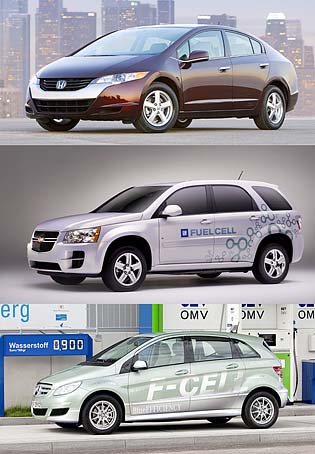 Hydrogen Fuel Cell Cars |
In 2005, Honda leased the first commercial FCV to a family in Redondo Beach, California. In 2008, the Honda FCX Clarity became the first production line built fuel cell lease vehicle rolled out to the same family plus dozens others. In late 2012, Hyundai started building production line fuel cell vehicles for sales to fleet managers worldwide.
For the past 36 years, the Los Alamos National Laboratory (LANL) has been conducting research on fuel cells for use in transportation, industry and residential use.
Unlike many of the hybrid and “green” vehicles currently on the market, hydrogen fuel cells can offer the promise of zero emission technology, where the only byproduct from the automobiles is heat and water vapor. Current fossil-fuel burning vehicles emit all sorts of pollutants such as carbon dioxide, carbon monoxide, nitrous oxide, ozone and microscopic particulate matter.
Zero Emissions …
Hybrids and other green autos address these issues to a large extent but only hydrogen cars hold the promise of zero emission of pollutants. The Environmental Protection Agency estimates that fossil-fuel automobiles emit 1 ½ billion tons of greenhouse gases into the atmosphere each year and going to hydrogen fuel based transportation would all but eliminate this.
Not only that, H2 autos will lessen the United States’ dependence upon foreign oil. The so-called “hydrogen highway” will mean less dependence upon OPEC, the big U. S. oil companies, oil refinery malfunctions and breakdowns and less resistance from oil-selling nations like Venezuela and Saudi Arabia or from hostile nations who would rather sell elsewhere.
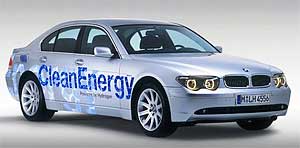 BMW with Hydrogen Internal Combustion Engine |
Consumers will finally get a break from the never-ending rising prices at the gasoline pumps.
|
President George W. Bush, when he was in office, allocated approximately $2 billion in hydrogen highway research funds. Former California Governor Arnold Schwarzenegger was pushing to get 200 H2 fueling stations built by 2010 stretching from Vancouver, British Columbia, all the way down to Baja, California (but had fallen short of this goal because of a poor economy and lack of political will).
Since Californians buy one-fifth of the nation’s automobiles, this location is one of the world’s hotbeds for FCV technology. This is especially true around the Los Angeles area.
New fuel cell technology could replace the current gasoline engine in what is called “disruptive technology” where something so innovative comes along it simply replaces the old technology very quickly (like the Internet or cell phones). A more likely scenario, however, is the slow, painstaking process of building a hydrogen refueling infrastructure in what is called a “cluster model”.
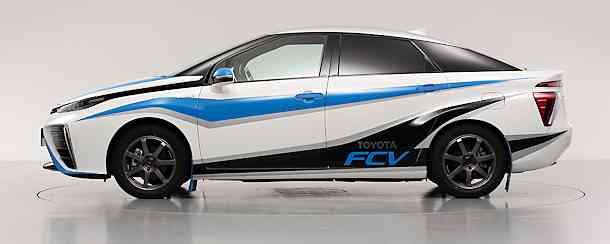 Toyota Mirai
Cluster Model …
This cluster model involves building hydrogen fueling stations in population centers like Los Angeles and San Francisco and rolling out hydrogen cars in the same locations. Afterwards, more large cities will get clusters of H2 refueling stations and fuel cell cars. Eventually these clusters will need to be connected through infrastructure.
The conversion from gasoline-powered internal combustion engines to hydrogen-powered internal combustion engines is agreed upon by most scientists and engineers to be a particularly easy transition and would buy time for fuel cell cars to be fully adapted.
|
But all 8 major automakers are pushing for fuel cell vehicles and each one has one or more prototypes or even lease vehicles to back this up.
|
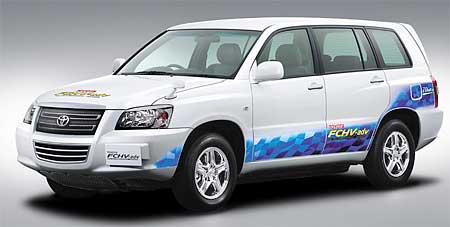 Toyota Fuel Cell SUV |
Let’s also not forget about hydrogen-on-demand vehicles are still contenders in the marketplance, avoiding the compressed or liquid hydrogen refueling scenario altogether. And, what about adapting hydrogen peroxide for fuel in cars since it is currently being used in race cars and jet packs as a propellant? These are other options to consider although they may be farther out on the timeline.
Hydrogen cars are the future, so why not take a test drive of this website right now and see what you’ll be driving a few short years from now. With Germany, Japan, Scandinavia, Great Britain and the U. S. in the hunt, the hydrogen economy is just around the bend. Are you ready?
As of June 10, 2014, Hyundai handed the keys to Tim Bush and family so that they can drive the first mass-produced hydrogen fuel cell vehicle available for lease by a consumer in the United States. Congratulations to the Bush family of Huntington Beach, California!
Note: the focus of this website is hydrogen cars, vehicles, infrastructure and economy and in that order. Are you ready for the ride?

Written by Hydro Kevin Kantola
This page was first published July 3, 2005
This page was last updated January 26, 2021